Retinopathy of prematurity (ROP)
Every premature baby deserves a timely eye check
In babies born early, the blood vessels of the retina have not finished growing. In some babies they grow abnormally. This is ROP. Untreated, it can lead to retinal detachment and blindness. Found on time, it can be treated.
ROP fellowship under Dr. Anand Vinekar, Narayana Nethralaya, Bengaluru
Watch: how ROP happens
Why premature babies need eye checks
During pregnancy, the blood vessels of the retina grow from the centre towards the edge, and are usually complete around the time of a full-term birth. A baby born early arrives before this growth has finished.
1/5Before birth, the retina’s blood vessels grow from the centre towards the edge.
2/5A baby born early arrives before this growth is complete. The edge of the retina has no blood vessels yet.
3/5In most babies, the vessels keep growing and safely reach the edge.
4/5In some babies, a white line and then a raised ridge forms at the border, and abnormal new vessels grow on it. Vessels near the optic nerve become wide and twisted (plus disease). This is ROP.
5/5Found in time, laser or an injection stops ROP. That is why every screening visit matters.
In short
- Retinal blood vessels grow from the centre to the edge before birth.
- In babies born early, the edge of the retina has no vessels yet.
- Usually the vessels keep growing normally after birth.
- Sometimes they grow abnormally: a line, then a ridge, then new vessels on it (stages 1–3), sometimes with wide, twisted vessels near the optic nerve (plus disease). This is ROP, and it can cause blindness.
- Timely screening finds ROP early, when laser or an injection can stop it.
Does my baby need screening?
Based on India’s national ROP screening guidelines. If you are unsure, ask your baby’s doctor or call me.
When should the first check happen?
Timing matters. ROP can progress within days, and treatment works best when it is given at the right stage.
Even if your baby has gone home from the NICU, the first check must still happen on time.
What happens at the exam
If treatment is needed
Most babies with mild ROP get better on their own and only need monitoring. When ROP reaches a stage that needs treatment, it should be given quickly, usually within 48–72 hours.
Advanced ROP with retinal detachment may need surgery.
A checklist for parents
After ROP settles, children born early still need regular eye checks for glasses, squint and lazy eye.
Common questions
My baby’s eyes look normal. Do they still need a check?
Yes. ROP cannot be seen from outside the eye, even when it is severe. Only a retinal examination can detect it.
Is the examination harmful to my baby?
It is a routine, safe examination. Babies may be uncomfortable for a few minutes and settle soon after.
How many check-ups will be needed?
It varies. Some babies need two or three; others need checks for several weeks or months. I will tell you at each visit when to come next.
Where is the screening done?
At Dr. Agarwal’s Eye Hospital, Indore. I am also available to screen babies in NICUs.
For neonatologists & NICUs
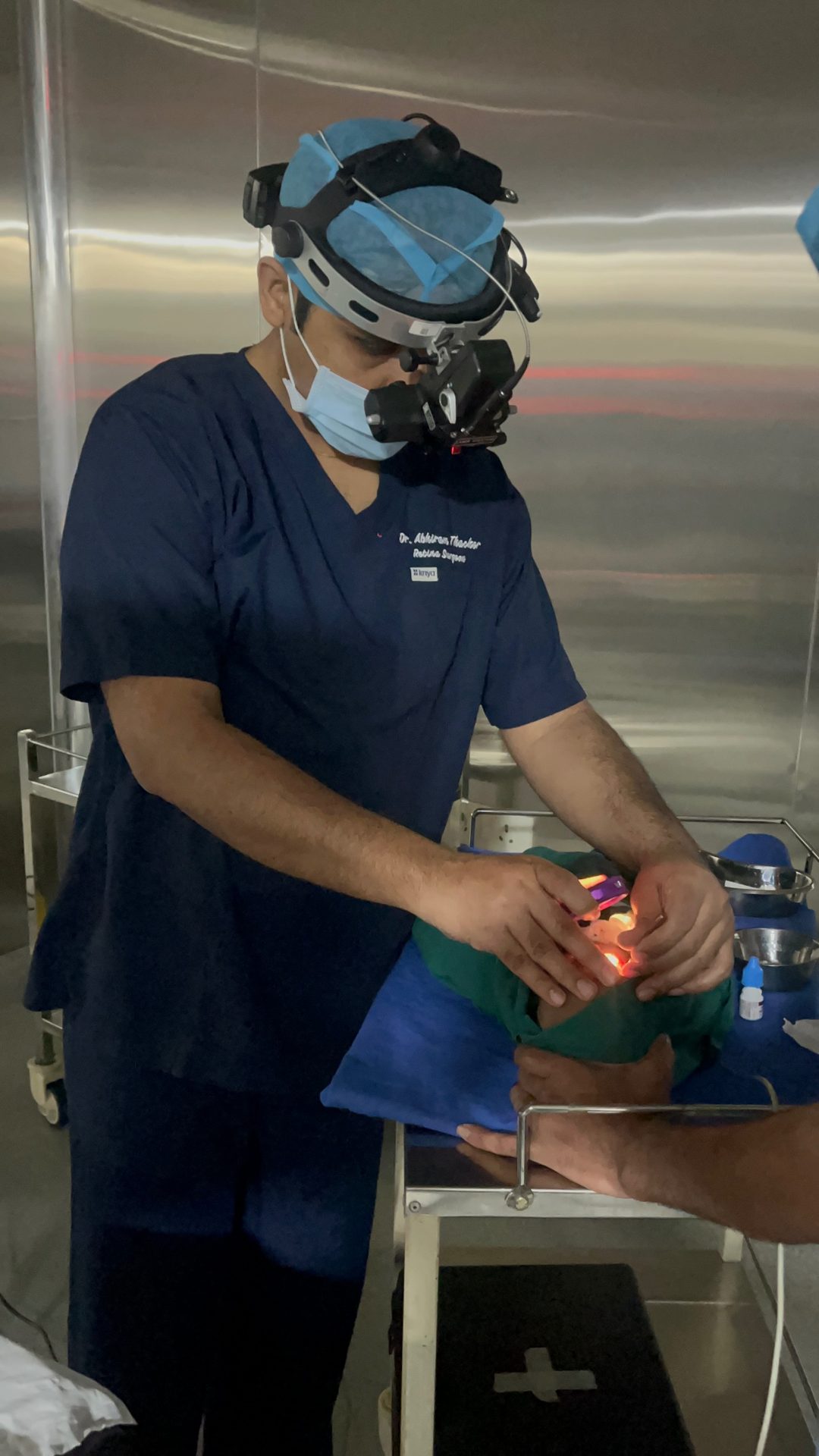
On-site ROP screening for your NICU
Trained in ROP under Dr. Anand Vinekar at Narayana Nethralaya, Bengaluru, I am available for bedside ROP screening and treatment planning for NICUs in and around Indore. Call or WhatsApp to set up visits or refer a baby.